Last updated: April 2026
Gibraltar has survived 14 sieges. None was more dramatic, more prolonged, or more consequential than the last one. The Great Siege of Gibraltar, launched in 1779 and finally abandoned in 1783, lasted nearly four years. The garrison, vastly outnumbered and cut off from resupply for months at a time, held the Rock. What they built to do it is still there, carved into the limestone above the town, and still one of the most remarkable things you can visit in Gibraltar today.
Quick Summary
- The Great Siege (1779-1783) was the 14th and final attempt to take Gibraltar from Britain
- Spain and France besieged the Rock during the American Revolutionary War, hoping to recover Gibraltar while Britain was distracted
- General George Augustus Eliott commanded the British garrison through the entire siege
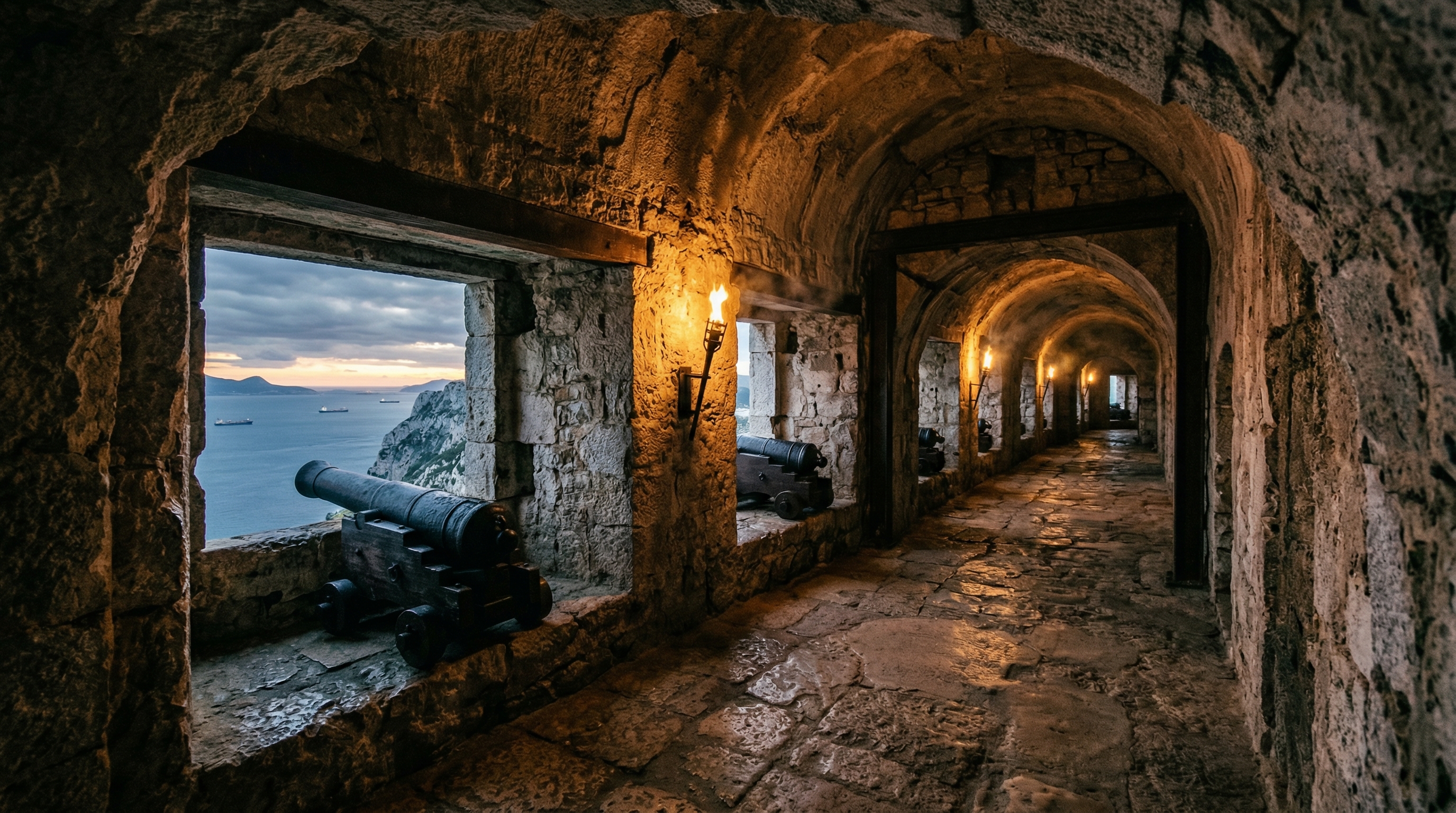
- The famous Great Siege Tunnels were excavated during the siege to position guns on the north face of the Rock
- The garrison held. Gibraltar remained British. It has not been besieged since.
- The tunnels are open to visitors today as part of the Upper Rock Nature Reserve
Why Did Spain and France Besiege Gibraltar in 1779?
Britain had held Gibraltar since 1704, when a combined Anglo-Dutch fleet captured it during the War of the Spanish Succession. Spain had been trying to get it back ever since. When the American Revolutionary War started in 1775, Spain saw an opportunity. Britain was stretched. Most of its military resources were focused across the Atlantic. The Spanish government, with French support, calculated that this was the moment to take the Rock back.
The siege officially began on 21 June 1779, when Spain closed the land frontier with Gibraltar, cutting off the garrison from its primary supply route. It was the start of what would become the longest siege in British military history.
At the time, the population of Gibraltar including military personnel numbered around 5,000 people. The besieging forces eventually numbered in the tens of thousands.
Who Was General Eliott?
The commander of the Gibraltar garrison was General George Augustus Eliott, and the siege largely became the story of one man's refusal to give an inch.
Eliott was 62 years old when the siege began, and is said to have lived mostly on vegetables and water throughout the ordeal. He imposed strict discipline, rationing, and an unwillingness to negotiate that bordered on stubbornness. In anyone else it might have looked like a character flaw. In this context, it was the quality that saved Gibraltar.
After the siege ended, he was rewarded with a barony. He became Baron Heathfield of Gibraltar, and there is a statue of him at the Alameda Botanical Gardens in Gibraltar, worth a look if you are walking through town.
How Did the Great Siege Tunnels Come to Exist?
The tunnels are the most tangible legacy of the siege, and the story of how they started is unexpectedly practical.
By 1782, the garrison needed to get guns onto a rocky projection on the northern face of the Rock called the Notch. The problem: there was no path, no ramp, no way to physically place a cannon there. General Eliott offered a reward to anyone who could solve the problem.
A soldier named Sergeant Major Ince proposed drilling through the rock itself. It sounds obvious in retrospect. In 1782, it was genuinely innovative military engineering.
When Ince's team began drilling, the fumes from blasting almost suffocated the workers. To get air into the tunnel, they opened a vent hole in the rock face. Standing at that vent hole, someone realised it was the perfect size and position for a cannon embrasure. The first gun port was an accident.
By the end of the initial tunnelling phase in 1783, approximately 908 feet (277 metres) of tunnels had been excavated. Five main galleries were created: Windsor Gallery, King's Lines, Queen's Lines, St George's Hall, and Cornwallis Chamber. The work was done entirely by hand, chiselling and blasting through solid limestone.
The Grand Assault: September 1782
The most dramatic episode of the entire siege came on 13 September 1782, when the combined French and Spanish forces launched what they called the Grand Assault. It was a mass coordinated attack intended to end the siege in a single day.
The centrepiece was a fleet of 10 floating gun platforms, specially constructed and advertised across Europe as unsinkable. They were enormous timber vessels, armoured with thick rope and cork to absorb cannon fire, mounted with heavy guns, and pushed forward by rowing galleys.
| Force | Strength |
|---|---|
| Floating gun platforms | 10 |
| Supporting warships | 40+ |
| Land troops along the isthmus | Over 40,000 |
| British garrison | Approximately 7,000 |
The British had prepared. Eliott's gunners had been heating cannonballs red-hot in furnaces specifically to set fire to wooden vessels. The floating batteries had never been tested under sustained fire from hot shot. By the end of the night, every single one was on fire or sunk. Thousands of men were killed or wounded. The Grand Assault was a catastrophic failure.
How Did the Siege End?
After the Grand Assault failed, it was clear Gibraltar would not fall. The siege dragged on into 1783, both sides exhausted and running out of appetite for the fight. When the Peace of Paris was signed in February 1783, ending the American Revolutionary War, it also formally ended the siege. Gibraltar remained British.
It has been British ever since. The 14th siege was the last. The current treaty negotiations between Britain and the EU are the modern version of that conversation, conducted with diplomats rather than artillery.
Visiting the Great Siege Tunnels Today
The tunnels are one of the most popular attractions in Gibraltar. They are accessible as part of the Upper Rock Nature Reserve, reached by cable car from the town centre or by taxi up the winding road to the top.
What You Will See
- The original tunnels and gun embrasures, exactly as excavated during the siege
- Period cannon displayed in firing positions in the galleries
- Dioramas and displays depicting scenes from the siege
- Views through the embrasures across the isthmus toward Spain
- Context panels explaining the construction, the assault, and the garrison's experience
Practical Information
- Access: Included in the Upper Rock Nature Reserve ticket
- Getting there: Cable car to the top, or taxi via Engineer Road
- Combined ticket: Covers the tunnels, the Moorish Castle, St Michael's Cave, and the macaque viewing areas
- Time needed: Allow 30 to 45 minutes for the tunnels alone; a full Upper Rock visit takes 2 to 3 hours
- Photography: Permitted throughout. The embrasure views toward Spain are particularly good.
Standing at a gun embrasure, looking out through a hole in solid limestone toward the Spanish lines, with the bay and the mainland spread out below you, is one of those moments that makes history feel real in a way that reading about it does not.
Beyond the Great Siege: The Full Tunnel Network
The Great Siege Tunnels were just the beginning. By the end of the 18th century, the network had expanded to nearly 4,000 feet (1,200 metres). Then came the Second World War.
During WWII, the Rock was tunnelled on an extraordinary scale. The military needed Gibraltar to house a garrison of 16,000 soldiers with enough food, water, ammunition, and fuel to survive a year under siege. Approximately 52 kilometres of tunnels were eventually excavated under the Rock. Only the Great Siege Tunnels section is open to tourists, but the scale of what lies behind the visible walls of the Rock is extraordinary.
The Bottom Line
The Great Siege of Gibraltar is not widely known outside Gibraltar and the UK, which is a genuine shame. It is one of the most dramatic military holding actions in modern European history: a small garrison, outnumbered many times over, cutting tunnels through a rock face while the rest of the British Empire fought a war on another continent. They held, and Gibraltar is still British as a direct result.
The tunnels are worth visiting. Not because of the dioramas or the cannon, but because you can stand in the exact place where it happened and look out through the same holes they cut, at the same view they had, toward the same isthmus where the besieging army waited. History does not often feel that immediate.
Frequently Asked Questions
When did the Great Siege of Gibraltar take place?
The Great Siege ran from June 1779 to February 1783, lasting approximately three years and seven months. It coincided with the American Revolutionary War, during which Spain and France attempted to recover Gibraltar while Britain was engaged elsewhere.
Who commanded Gibraltar during the Great Siege?
General George Augustus Eliott commanded the British garrison throughout the siege. After the siege ended successfully, he was elevated to the peerage as Baron Heathfield of Gibraltar. A statue of him stands at the Alameda Botanical Gardens in Gibraltar.
Can you visit the Great Siege Tunnels?
Yes. The Great Siege Tunnels are open to visitors and are included in the Upper Rock Nature Reserve admission ticket. They are typically reached by cable car or taxi from the town centre, and a full visit takes around 30 to 45 minutes.
How long are the Great Siege Tunnels?
The original tunnels excavated during the siege stretched approximately 908 feet (277 metres). By the end of the 18th century this had expanded to nearly 4,000 feet. During WWII, over 50 kilometres of tunnels were eventually excavated across the entire Rock.
Was the Great Siege the last time Gibraltar was besieged?
Yes. The Great Siege of 1779 to 1783 was the 14th and final siege of Gibraltar. No military attempt to take the Rock has been made since. The siege ended with the Peace of Paris in February 1783, and Gibraltar has remained under British sovereignty since 1704.