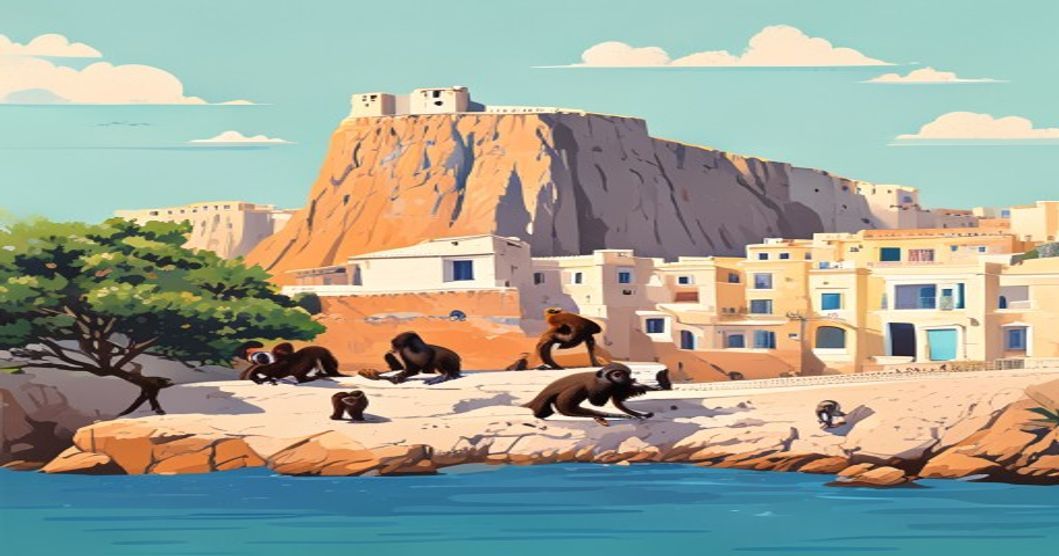
Gibraltar's Barbary macaques are Europe's only wild primates, with around 230 to 300 animals living across the Upper Rock Nature Reserve. Managed by GONHS (Gibraltar Ornithological and Natural History Society), they are most reliably seen at Apes' Den near the middle cable car station at Queen's Gate. Feeding them carries a fine of around £4,000 as of 2026. They are listed as Endangered on the IUCN Red List.
Key Facts at a Glance
- Around 230 to 300 Barbary macaques live on the Upper Rock in several distinct troops (as of 2026)
- The only wild primates in Europe
- Originally from North Africa, primarily Morocco and Algeria, though their precise arrival in Gibraltar is debated
- Protected under Gibraltar law: feeding them carries a fine of around £4,000
- The famous legend: if the macaques ever leave the Rock, Gibraltar will cease to be British
- Best viewing spot: Apes' Den, near the middle cable car station at Queen's Gate
What Are Barbary Macaques?
Barbary macaques (Macaca sylvanus) are a species of Old World monkey native to the Atlas Mountains of North Africa, primarily Morocco and Algeria. They are the only non-human primates found wild in Europe, which makes Gibraltar's population genuinely remarkable from a biogeographical standpoint.
They are medium-sized primates, typically weighing between 5 and 15 kilograms. Despite being macaques, they are tailless, which is why visitors often hear them called "Barbary apes." They live in multi-male, multi-female social groups with complex hierarchies, and males play an unusually active role in infant care, something relatively rare among primates.
How Did They Get to Gibraltar?
The exact origin of Gibraltar's macaques is genuinely debated among historians and zoologists. The main theories are:
- Moorish introduction: The most widely cited explanation is that the Moors brought macaques to Gibraltar during their centuries-long occupation of the territory. The close connection between North Africa and Gibraltar made this kind of movement natural, and keeping these animals was part of that culture.
- Natural crossing: Some researchers believe macaques may have crossed the Strait of Gibraltar at some point in the distant past. The Strait is only about 13km wide at its narrowest point, so the crossing, while challenging, is not impossible to imagine over a long timescale.
- British supplementation: There is documented evidence of British officials bringing macaques from North Africa to replenish the population at various points, most notably during World War II when numbers fell dangerously low.
The truth is probably a combination: an original population arrived or was brought at some early stage, with periodic supplementation when numbers fell. This pattern continues in a managed way today under GONHS oversight.
The Legend of the Macaques
Gibraltar's most famous macaque legend holds that if the macaques ever leave the Rock, Gibraltar will cease to be British. The origin of this belief is unclear, but it was taken seriously enough during World War II that Churchill personally ordered reinforcements be brought from North Africa when the population dropped to just a handful of animals.
Today the population is carefully managed by the Gibraltar Ornithological and Natural History Society (GONHS) in partnership with the Gibraltar Government, ensuring numbers stay stable. The legend lives on as a cherished part of Gibraltar's cultural identity, even if modern Gibraltarians treat it as folklore rather than cause for anxiety.
During World War II, when Gibraltar served as a strategically vital Allied base, Churchill sent a message to the Governor of Gibraltar specifically ordering that the macaque population be maintained. He viewed the legend as important for civilian and military morale during a period of intense uncertainty. Animals brought over from Morocco during this period are among the ancestors of today's population.
How Many Macaques Are There Today?
The population is managed by GONHS (Gibraltar Ornithological and Natural History Society, gonhs.org) alongside the Gibraltar Government. Current estimates put the population at around 230 to 300 individuals as of 2026, distributed across several troops occupying different parts of the Upper Rock.
Each troop has its own territory within the Upper Rock Nature Reserve, along with its own hierarchy and social dynamics. The troops are monitored regularly and significant changes in health or numbers are acted on promptly. Macaques that become overly food-dependent or aggressive through tourist contact are sometimes relocated within the reserve or given behavioural interventions to discourage the pattern.
While the macaques are primarily resident in the Upper Rock Nature Reserve, individual animals and small groups occasionally make their way lower down the Rock and sometimes into town. These incursions are monitored by GONHS, as urban-habituated macaques present greater risks to themselves and to residents.
Where to See the Macaques
The macaques live throughout the Upper Rock Nature Reserve, but the most reliable place to find them is Apes' Den, located near the middle cable car station at Queen's Gate. This is where troops gather most consistently and where most visitors encounter them first. It is also where the macaques are most habituated to calm human presence.
Other reliable spots include:
- St Michael's Cave and surrounding terrain: Troops frequently pass through this area and the rocky landscape suits them well
- Great Siege Tunnels area: The rugged ground around the tunnels is another reliable macaque habitat
- Cable car top station: Macaques often congregate near the top terminal, sitting at around 412 metres
- Mediterranean Steps: Those hiking up from the south side of the Rock regularly encounter macaques along this route
You do not need to go actively hunting for them. Walk through the Upper Rock Nature Reserve at a calm pace and you will almost certainly encounter them. During the main tourist season from spring through autumn, sightings at Apes' Den are practically guaranteed.
Accessing the Upper Rock Nature Reserve via the cable car costs around £49 return as of 2026, which includes Nature Reserve entry. The top station sits at approximately 412 metres, with the Rock's highest point at 426 metres.
Rules for Interacting with the Macaques
The rules exist for the macaques' wellbeing as much as visitor safety:
| Rule | Reason |
|---|---|
| Do NOT feed the macaques | Human food causes health problems and makes them aggressive and food-dependent. Fine of around £4,000 as of 2026. |
| Do NOT touch the macaques | Zoonotic disease risk in both directions, and contact can provoke defensive bites |
| Do NOT approach babies or interfere with social interactions | Adults defend infants fiercely; interference can trigger aggression from the whole troop |
| Keep bags and food out of sight | Macaques are clever and opportunistic. An open bag will be investigated |
| Move slowly and quietly | Sudden movements can alarm individuals or entire troops |
Feeding macaques is illegal in Gibraltar and the fine runs to around £4,000 as of 2026. This ban exists because decades of tourist feeding produced serious behavioural problems, including obesity, aggression, and dependency that caused real harm to the animals. The population is healthier today partly because the feeding ban is properly enforced.
Stay calm and avoid sudden movements. If an individual seems agitated, avoid direct eye contact as this can be read as a challenge. If one jumps onto you, remain still and it will typically move on quickly. Do not scream or wave your arms. Most encounters are benign curiosity. These animals have seen large numbers of tourists over the years and are generally relaxed around calm visitors.
Conservation Status
The Barbary macaque is listed as Endangered on the IUCN Red List. The species has declined significantly across its native North African range due to habitat destruction, illegal wildlife trade, and hunting. Gibraltar's population is, somewhat ironically, one of the better-managed and more stable macaque populations anywhere, precisely because of the active conservation work carried out by GONHS and the Gibraltar Government.
Gibraltar contributes to international discussions on Barbary macaque conservation, and the animals here serve as both a conservation success story and an education opportunity about the pressures the species faces across Morocco and Algeria.
Frequently Asked Questions
Are the macaques dangerous?
Macaques are wild animals and deserve respect. Unprovoked aggression is rare, but macaques will bite if they feel threatened, if competing for food, or if you get close to a mother with a young infant. Follow the rules, keep food out of sight, avoid trying to touch them, and the vast majority of encounters will be peaceful.
Can I see the macaques without paying to enter the Upper Rock Nature Reserve?
The Upper Rock Nature Reserve requires a ticket. The cable car return ticket, around £49 as of 2026, includes Nature Reserve entry. Reliable macaque sightings at Apes' Den and the main Upper Rock areas require some form of paid entry. Occasional sightings lower down the Rock do happen, but cannot be counted on.
What time of day is best for macaque sightings?
Morning tends to be best, before the heat of the day and before tourist numbers peak. Macaques are most active during cooler parts of the day. Early morning between 9am and 11am in summer gives good light and more active animals. At midday in July and August they tend to rest in shaded spots and can be harder to find.
Do the macaques bite?
They can and do bite occasionally, almost always when people ignore the rules by reaching out to touch them, getting between a mother and infant, or having food visible. Follow the guidance and encounters are very rarely problematic.
Are there macaques anywhere else near Gibraltar?
The Gibraltar macaques are resident on the Upper Rock Nature Reserve and do not regularly cross into Spain. Barbary macaques do not naturally occur anywhere else in Europe. The species exists in the wild only in Morocco, Algeria, and Gibraltar.
Why are they called Barbary apes if they are macaques?
The name Barbary ape comes from the Barbary Coast, the old European name for the North African coastline. They were called apes partly because of their lack of a visible tail, which was historically used to distinguish apes from monkeys. In scientific terms they are macaques, a genus of Old World monkeys. The ape label stuck through centuries of common usage and remains the local term you will hear on the Rock.